

April is National Poetry Month, which means I’m obligated by the laws of being a writer to tell you that I’ve been writing poetry since I was old enough to understand that feelings could be arranged into lines.
What I’m not obligated to tell you (but will, because Overshare is my jam) is that some of those early poems were absolutely, magnificently, catastrophically dramatic.
Exhibit A:
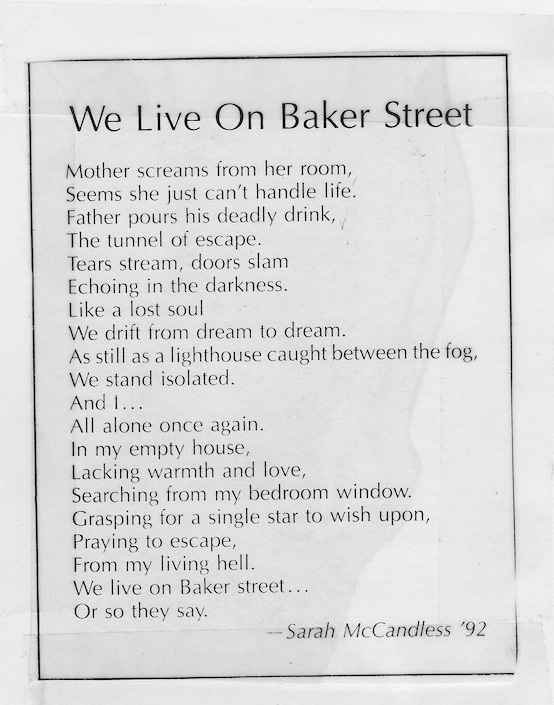
That is “We Live on Baker Street,” written by one Sarah McCandless, age 14, freshman at Grosse Pointe South High School, class of 1992. It won an honorable mention in the 1989 National Scholastic Writing Awards, chosen from 24,000 entries.
Honorable Mention.
The Grosse Pointe News ran my picture as though I had won a gold medal.
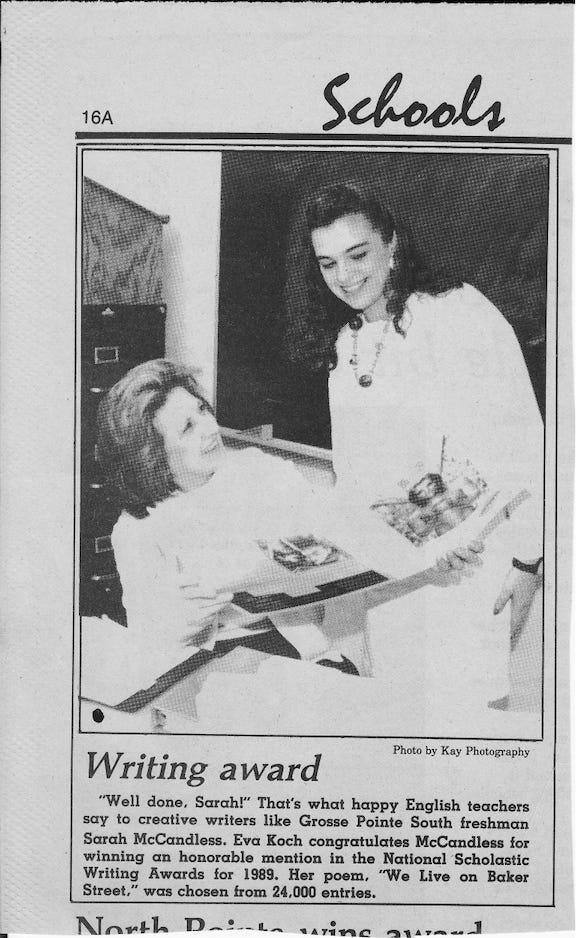
(props to my mamma for keeping the clipping)
To be clear: I have never experienced a single thing described in that poem. But at 14, channeling every dramatic thing I had ever read or watched or imagined into twenty lines about a life I had not lived felt like the most honest thing I could do.
Inspiration source materials included but were not limited to:
Every ABC Afterschool Special, particularly that really bleak one trying to be a modern day Romeo & Juliet starring Molly Ringwald.
The entire V.C. Andrews Flowers in the Attic canon, yes, all the way through Seeds of Yesterday.
The oh-so-hetero, girl-has-yet-to-find-her-own-agency, waiting-to-be-chosen blueprint of “boy realizes girl was always the one.” See: Jake Ryan showing up for Sam at the end of Sixteen Candles, Blane showing up for Andie at the end of Pretty in Pink.
Tiger Eyes by Judy Blume (I think this is also what started my love affair with New Mexico).
Beverly Hills, 90210: more Brenda-Dylan-Kelly storylines, less Donna Martin Graduates or David Thinks He Can Sing.
I desperately craved something dramatic, or at least something interesting, to happen to me, primarily so I could enter (and win) Sassy magazine’s Sassiest Girl in America contest (and then be asked to join the editorial team, permanently).
In the meantime, I channeled all that had NOT happened to me into make believe short stories and poems.
Which are, of course, now extremely funny in retrospect.
Here’s another story behind the story in that newspaper photo: the outfit I’m wearing. It was a deliberate recreation of a look worn by Cindy Mancini in Can’t Buy Me Love, specifically the airplane graveyard scene.

Cindy Mancini, for those who need a refresher, was the most popular girl in school, but her secret shame was that she wrote poetry. Because DUH you can’t be a popular girl AND write poetry. GROSS.
Let’s just say me and Cindy were also two peas in a pod when it came to the “quality” of our work. A line from her pièce de résistance (that Ronny / Ronald later co-opts and uses as his own to get in another girl’s pants):
Someday my wish is for him to hold me in his arms,
in a sea of deep blue,
together at last,
together as two.
Maybe Cindy should have received the honorable mention?
Regardless, I was dressing like a secret poet… while winning a national poetry award. Make of that what you will.
The teacher in that newspaper photo, the woman beaming as she hands me what appears to be an award or a certificate, is Mrs. Koch. Eva Koch, though she was always Mrs. Koch to me (pronounced Cook).
She was my first true mentor.
I was one of maybe three freshmen who landed a spot in her Creative Writing class. I don’t know exactly how I got in, but I know what it felt like: like someone had seen something in me before I had fully seen it in myself. She had thick reddish brown hair and she was always so put together. She had handwriting I loved, cursive (a lost art), beautiful in both presentation and content, script that made you want to be the person whose work she was writing on. I still have drafts with her notes tucked away somewhere. I have never been able to throw them out.
She also created Imprints, the literary journal at Grosse Pointe South that gave student writers, photographers, and artists a home for their work. I appeared in every single issue during my four years there, and I was the editor my senior year.
She built the thing that built me.
Mrs. Koch passed away in January 2022. She was 88 years old and she had spent most of her life in service of other people’s language. When I found her obituary in, where else, the Grosse Pointe News, I sat with it for a long time.
I don’t think I would be a writer without her. I know I wouldn’t be the writer I am.
The poetry got better. That’s not a brag, that’s just the truth of what happens with more time and dedication to the craft, including immersing myself in the greats, the true gold medalists: Nikki Giovanni, Margaret Atwood, Kwame Alexander, Carolyn Forché, Anita Skeen, Pablo Neruda, Mary Oliver, Mindy Netifee.
Here’s something I wrote more recently. Not about a life I hadn’t lived, but about one I had lived, was living, and paying attention to:
In Solstice, Winter
I have never relied on vision
to see my way through your dark.
There are always clues when you’ve reached
maximum tilt away from the sun.
The waft of mildew upon discovery
of damp clothes left behind
in the washer. Toast served
burnt and dry.
Weak and bitter
coffee. How your body remains
a frozen tundra
because there is never enough warmth
from my touch.
Here is what I know to be true:
This is how you spin.
And when you enter
your most distant, southern point,
your shortest day and longest night,
what appears might be your final standstill,
I will continue to orbit around your orbit,
gazing at the possibility
of our rebirth.
Here’s what I’ve been thinking about this April, during this particular National Poetry Month, in this particular moment in the world:
Poetry is not only what lives on the page.
I see it in the desert sunrises and sunsets in Las Vegas. The kind of sky that stops you mid-sentence, that demands you look up and stay looking. There is no other word for what those skies are doing except poem.

I see it in my significant other in a thousand ways, including how he makes me coffee every morning and brings it to me without being asked. That’s not a small gesture. That’s a sonnet.
And I saw it last weekend at the Boston Marathon, in a video that has now been seen by millions: two strangers helping a runner who was struggling to stand and cross the finish line. Just reaching out. Holding someone up. Making sure they got there.
If that’s not poetry, I don’t know what is.
April is the month we officially designate for it, which I appreciate. But poetry doesn’t wait for April. It shows up in handwriting on a draft. In a sky that won’t let you look away. In a partner who thinks about your needs before you’ve even thought about them yourself. In two people at mile 26.2 who decided that finishing together mattered more than finishing first.
And it showed up in a ninth grader wearing her best cobbled together Cindy Mancini outfit, writing about a life she hadn’t lived yet, reaching for language.
Because reaching for language was the only thing that made sense.
And still is.
xo,
SG
Hopeless Semantic lands in your inbox on Wednesdays. If someone in your life belongs here, send them this way.
You were so dramatique! I guess I should use the present tense or maybe both tenses. You were and are so dramatique! In the best sense