

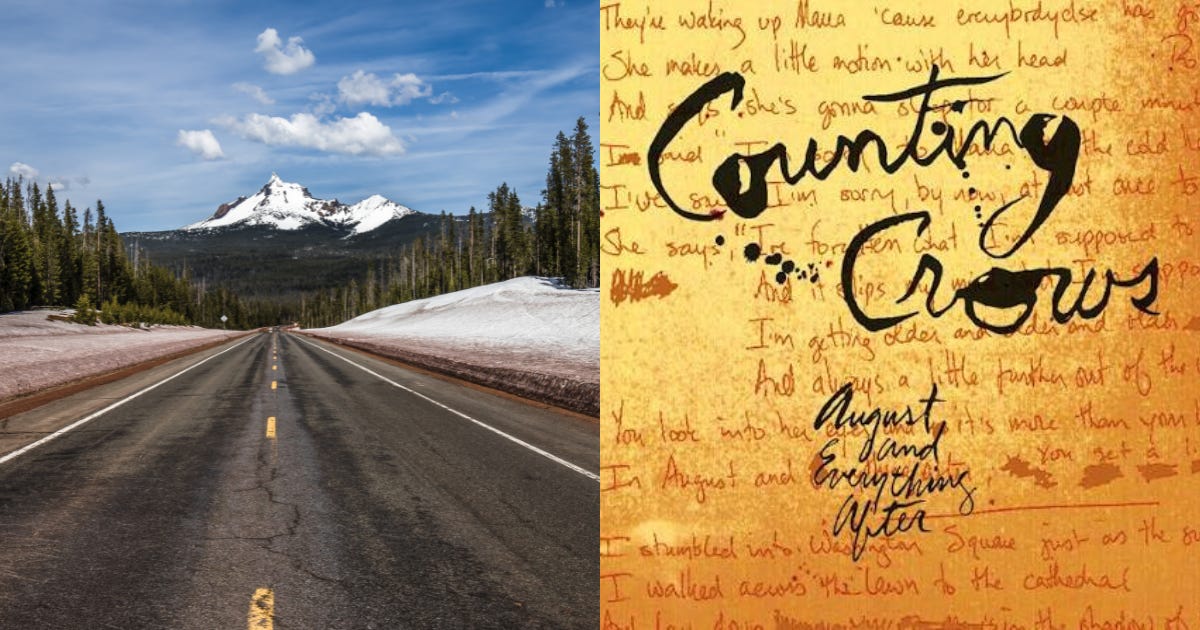
Back in the 1900s – May 1994 to be exact – before smartphones, before iPods, at the cusp of a more widespread birth of email and “the interwebs,” we consumed our music through what was played on the radio (Google it) and or primarily by way of cassette tapes and compact discs aka CDs. Independent shops selling both new and used CDs were also common at that time, particularly in college towns. Like the one in Eugene, Oregon, home to University of Oregon, where I procured my very own copy of Counting Crows’ August and Everything After.
U of O was not where I was earning my degree – that would be Michigan State University – but where my sister-from-another-mister Carey was earning hers, and it’s also where I kicked off my first summer living anywhere but Michigan. I’d known Carey my entire life. Literally. Our dads had been best friends since they were five years old, growing up together in Grosse Pointe, Michigan, which is also where I spent most of my formative years. Carey never lived there, but she would come back with her dad and siblings to visit her paternal grandmother. She was one year older than me and we started a pen pal relationship around the time I was ten. I took my first trip to visit her on her side of the world in my early teens.
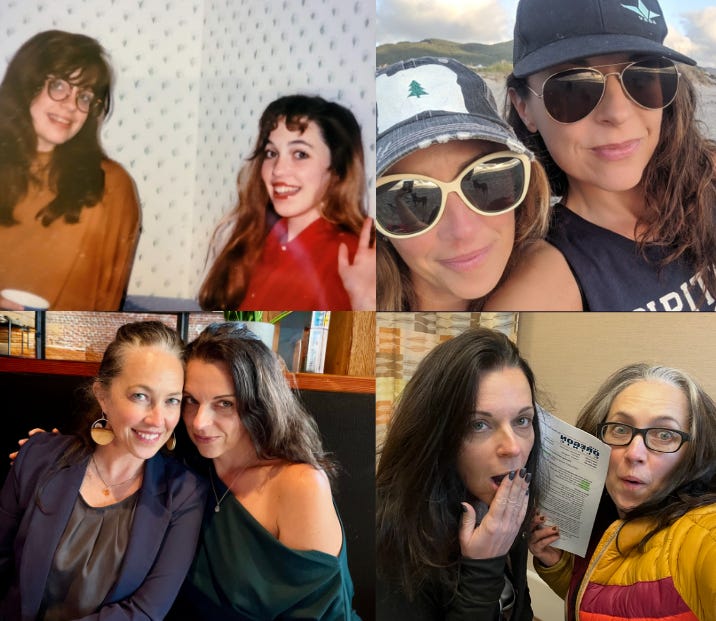
Carey lived with her mother in Leaburg, Oregon, on the McKenzie River approximately twenty-two miles east of Eugene, and it looked nothing like the Detroit suburbs. Lush green forests, snow capped mountains in the distance, gray skies that felt like hugs transitioning into glorious sun breaks no one took for granted. I fell in both enchantment and love, and my trips to the Pacific Northwest became an annual event, then transitioned to the setting for “What I Did on My Summer Vacation” the year between my sophomore and junior year of college.
I arrived in Oregon in early May, when my term at MSU ended. Carey was on a different academic calendar at U of O, and still had a good month left of classes, so I found a job I knew I’d quit three weeks later when we headed to our real summer job destination in central Oregon. That short term gig was my first and last telemarketing role, where I’d run down a call list primarily of vulnerable elders to inform them they’d won a cash prize. The point of the call was to use this EXCITING news as a lure to con them into buying a water filter system with a price tag of hundreds of dollars (that probably costs $1.56 to make in China). Our call script never disclosed the amount of the cash prize ($20), and if memory serves, we were only legally required to do so if the person said something along the lines of, “I do not want to buy anything, I just want the cash prize.” You’d be shocked by how many people NEVER asked about the amount, let alone coupled it with the “do not want” part of the statement. Even so, I only closed one sale in three and a half weeks. As part of my absolution, I called my grandparents and coached them on what to do if they ever received such a call, but I still carried guilt from that one sale for years.
Let’s just say when the time came to pull the plug, it was a very, very easy job to quit. And no, giving two weeks notice was not part of the package.
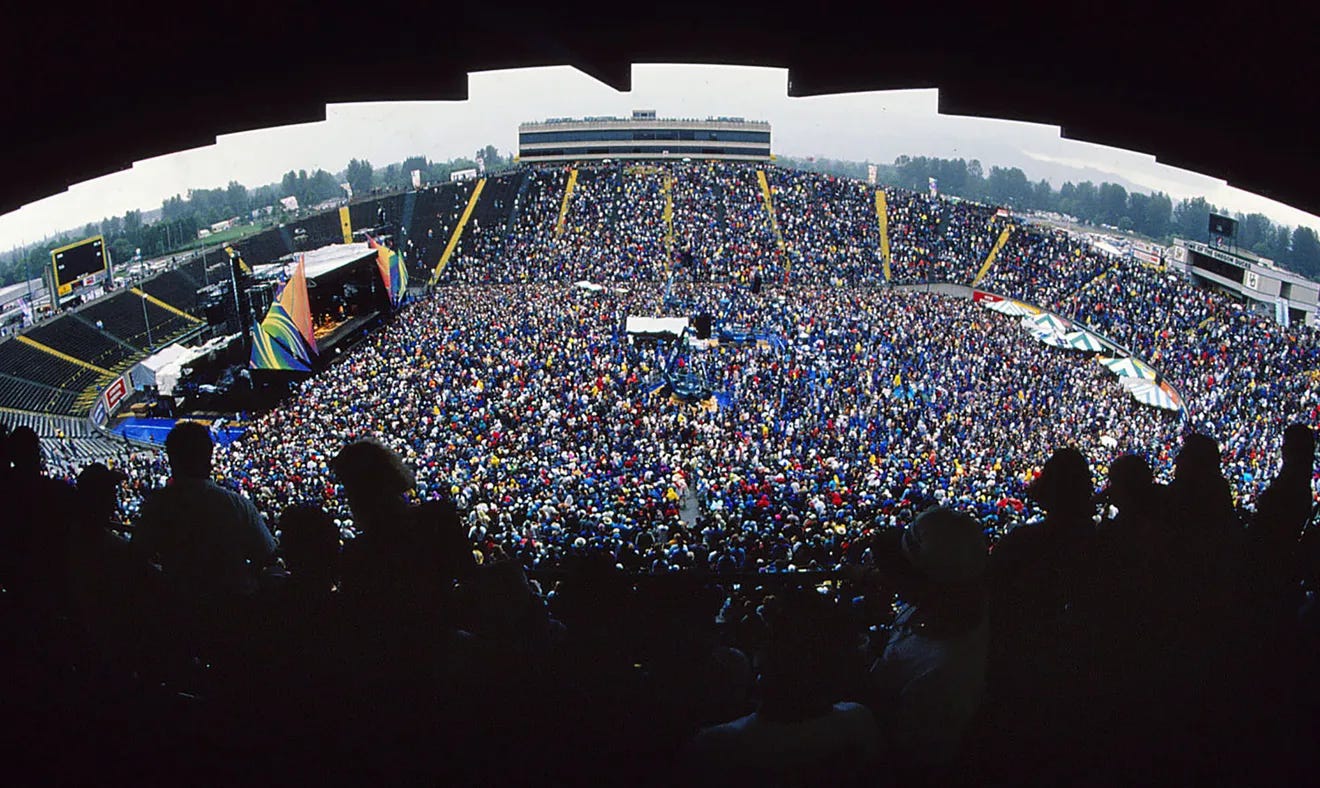
During this time, we also saw the Grateful Dead at Autzen Stadium in Eugene, which turned out to be just about a year before Jerry Garcia died. I knew maybe two songs. People kept walking past us going “Dose? Dose?” and I spent an embarrassingly long time thinking they were asking if there were two of something, in Spanish, before I understood what I was actually being offered.
Then we headed to central Oregon, and the real summer started.
Carey had already worked two seasons as a server at the Provision Company at Sunriver Resort, just south of Bend. This was the more casual restaurant in the main lodge, as opposed to the Meadows, which had fancy cloth napkins and an actual wine list. She was sure she could get me a job there too, and she was right. I hosted. She served. My boss was a guy named Bob Cannon, who I was positive at the time was a fully formed much older adult, not because he looked older (not that there’s anything wrong with that), but he just seemed to have his shit together. I’ve since done the math and realized he was maybe 26 to my 19 going on 20. I would later have the pleasure of breaking bread with him in Portland as true adults in our 30s and 40s and we’re still in touch through the socials. He remains one of the best bosses I’ve ever had.

Four (or was it five or six?) others plus me and Carey lived in a house on the resort property and split rent that came out to just under two hundred dollars a month each. I couldn’t have been making more than five bucks an hour if that (and no tips for the hostess), and for a few weeks I also worked at the grocery store on the property, but that was short-lived. Having a morning-into-day second job didn’t bode well with the restaurant life schedule. We started mid-afternoon, ran until nine or ten at night, partied until two or three in the morning, slept until noon, then back to the restaurant by two p.m. Shampoo, rinse, repeat. I smoked constantly. I drank a lot of bad beer and cheap booze. Carey and I kept a journal that summer, passing it back and forth, taking turns scribbling and pasting in mementos. There is a particularly accurate drawing she did of me throwing up after a deadly combination of Sun Country wine coolers and Chicken in a Biscuit crackers. There is a lot of orange in said drawing. Today me loves that 1994 us documented our adventures, when we were certain about both everything and nothing.
August and Everything After played through all of it. It had actually come out the previous fall, but I didn’t have my own copy until the beginning of that summer. This was also a time when you still primarily listened to an entire album from start to finish, so I knew every song, not just the released singles. Sure, you could skip tracks on a CD player, but there was never the urge to do so with that particular album. And yes, we were making mixtapes back then, but that was a different art that took a lot more time and care than the immediacy of making a playlist today.
That album was about the only thing I made out with all summer long, from, “Oh lord, I’m not ready for this sort of thing,” and “I am feathered by the moonlight falling down on me,” to, “There’s things I remember and things I forget, I miss you, I guess that I should,” and, “It’s almost everything I need.” Adam Duritz gave the finger to pitch-perfect traditional singing standards and leaned hard into a vocal style that was loose, raw, achy, and emotional. He made no apologies for it – or for wearing dreadlocks at the time, which absolutely no one was having a conversation about in 1994, but sure as hell would now.
Thirty plus years later, I no longer smoke, drink, or pay $197 a month in rent. Both restaurants at Sunriver are now gone and have evolved into something else, and what used to be my end-of-shift time is now my bedtime (if not earlier). But that album has always remained in my top ten and in heavy rotation, regardless of who the Counting Crows have become since.
August and Everything After also stopped being just the title of a favorite album. It’s a phrase I reach for to describe any hinge point, including that last full swing of summer before everything tips toward fall (my favorite season). But even more broadly and beyond that, those moments when we experience a necessary (if at times painful) shift to make room for what’s to come.
And maybe it’s no mistake that the last song on the album closes out on this sentiment, too.
“Change, change, change, change… change.”
XO,
SG
Hopeless Semantic lands in your inbox on Wednesdays. If someone in your life belongs here, send them this way.
Keeper of my secrets, tender of my memories. I’d do it all again with you. Every bit. Even the chicken in a biscuit.
I love this so much! Not just because that album has the same kind of visceral call-back for my own memories but because the way it's written could be its own limited series that I would want to watch and tell everyone about. A slice of a season in the calendar, in life and in spirit!